


Restorative Dentistry in Northampton

Preserve your teeth. Restore comfortable function. Keep the result looking natural.
Whether you have a broken tooth, worn teeth, a failing filling or more complex dental problems, good restorative dentistry starts with understanding why the problem has happened.
At AK Dental Care, restorative dentist Ignacio Farga Niñoles looks beyond individual teeth, considering your overall oral health, existing dental work and bite before recommending treatment. His focus is on preserving natural tooth structure, restoring comfortable function and achieving natural-looking results designed to last.
Because sometimes the best treatment is less treatment.
Why choose Ignacio at AK Dental Care?
“Good restorative dentistry starts with understanding why a tooth has failed, not simply repairing
what has broken.”
Ignacio Farga Niñoles
For Ignacio, restorative dentistry isn't simply about repairing a damaged tooth. Every restoration begins with understanding why the problem occurred and determining the most conservative way to restore it. Whether treatment involves a filling, crown, veneer or more complex rehabilitation, the objective remains the same:
✓ A preservation-first approach
Healthy natural tooth tissue is precious.
Wherever possible, Ignacio uses modern adhesive and minimally invasive techniques to preserve healthy enamel and tooth structure rather than removing it unnecessarily.
✓ Diagnosis before treatment
A broken filling or worn tooth may be the visible problem, but it isn't always the whole problem.
Before recommending treatment, Ignacio considers what caused the damage in the first place.
That might include decay, an old restoration, cracking, grinding, acid erosion or the way your teeth meet when you bite.
Understanding this allows us to treat the cause as well as the damage.
✓ Natural-looking dentistry
Restorations shouldn't immediately look like dental work.
Careful attention is given to colour, shape, surface texture, proportions and polish so that your restoration blends naturally with the surrounding teeth.
✓ Your bite matters
How your teeth meet can have an important influence on how restorations perform.
For this reason, your bite is assessed carefully when planning treatment and checked again once your restoration has been fitted.
✓ Precision at every stage
The small details matter.
From isolation and adhesive bonding through to the fit, margins, bite and final polish, each stage is approached carefully and methodically.
Experience & expertise
Ignacio has more than 15 years' clinical experience and a particular interest in complex restorative dentistry, tooth wear and full-mouth rehabilitation.
His practice combines advanced restorative training with a meticulous, minimally invasive approach to treatment.
15+ years' clinical experience
Master's degree in Prosthodontics
Former Clinical Tutor in Restorative Dentistry
Queen Mary University of London
Published author & peer reviewer
International Journal
of Esthetic Dentistry
MSc Implantology
European Association of Prosthodontics certification
Diploma in Implant Dentistry
Royal College of Surgeons of England
See the results of carefully planned restorative dentistry
Every patient and every smile is different. Explore some of Ignacio’s restorative cases to see how careful diagnosis, detailed planning and a minimally invasive approach come together in real treatment.
Treatments
Complex restorative dentistry / full-mouth rehabilitation
What can restorative dentistry help with?
You may benefit from a restorative consultation if you have:
-
A broken or chipped tooth
-
A cracked or weakened tooth
-
A large or failing filling
-
An old crown that needs assessing
-
Worn or shortened teeth
-
Teeth damaged by grinding or acid erosion
-
Sensitivity associated with tooth wear
-
Several teeth requiring treatment
-
Difficulty chewing comfortably
-
Concerns about the shape or appearance of your teeth
-
Dental treatment that feels as though it has become increasingly complicated
Not sure what treatment you need?
You don't need to know.
Your first appointment is about establishing what is happening and why.
We will explain what we find, which areas are healthy, what may simply need monitoring and where treatment could be beneficial.
Where there is more than one sensible option, these will be discussed with you so that you can make an informed decision.
Composite fillings
"The aim is for the restoration to disappear into your natural tooth."
Ignacio Farga Niñoles
When a tooth is damaged by decay, cracking or wear, the first step is understanding why it happened.
Ignacio uses modern adhesive techniques to restore damaged teeth while preserving as much healthy tooth structure as possible. Restorations are carefully shaped, polished and colour-matched so that, wherever possible, they blend naturally with the surrounding tooth.
What you can expect?
-
Comprehensive diagnosis before treatment - The tooth and surrounding area are assessed before treatment so that we are confident a composite restoration is the right option.
-
Comfortable treatment - Local anaesthetic is administered gently and carefully.
-
A clean, controlled environment - We use rubber dam isolation for bonded restorations, this keeps the tooth clean and dry and allows us to create the best possible conditions for a strong, predictable bond.
-
Strict adhesive bonding protocols
-
Clinical photographs throughout treatment
-
Careful bite assessment and adjustment - Once the restoration has been completed, your bite is checked to make sure the tooth feels comfortable and that there are no unwanted contacts.
-
Detailed finishing and polishing - The final restoration is carefully shaped, textured and polished to reproduce the natural appearance of the tooth.
Crowns and partial crowns
"A crown should fit precisely, protect the tooth and feel like your own."
Ignacio Farga Niñoles
A badly damaged tooth sometimes needs additional protection. But not every damaged tooth needs a full crown.
Depending on how much healthy tooth remains, a more conservative option such as a partial crown, overlay or bonded restoration may provide the protection the tooth needs while preserving more of your natural tooth.
This is why careful diagnosis comes first. Ignacio assesses the condition of the tooth, any existing restorations, cracks, your bite and the amount of healthy tooth structure remaining before recommending the most appropriate treatment.
What makes Ignacio's approach different?
✓ Preserving healthy tooth structure - Preparations are kept as minimally invasive as possible, removing only what is necessary while retaining healthy enamel and tooth tissue wherever possible.
✓ Precision at every stage- From comfortable local anaesthetic and careful tooth preparation to the final fit, bite and polish, each stage is approached with meticulous attention to detail.
✓ Modern materials and adhesive techniques - The restorative material is carefully selected according to the needs of your tooth, taking into account strength, appearance and long-term bonding. We routinely isolate the tooth with a rubber dam during bonded treatments to keep the tooth clean and dry, allowing us to create the best possible conditions for a strong, predictable bond.
✓ Close collaboration with the dental laboratory - Detailed photographs, shade analysis and precise instructions are shared with a high-quality dental laboratory to help create a restoration that fits accurately and blends naturally with your smile.
✓ Care while your final restoration is being made - A carefully fitted temporary restoration helps protect your tooth and remain secure while your definitive crown or partial crown is being created.
✓ Careful final checks - Before treatment is completed, the restoration is assessed for its fit, margins, bite, appearance and polish. During final bonding we isolate the tooth with a rubber dam. This keeps the tooth clean and dry and allows us to create the best possible conditions for a strong, predictable bond.
✓ 3,000+ crowns documented - Ignacio has documented more than 3,000 crowns throughout his clinical career, bringing extensive restorative experience to the planning and delivery of each case.
If a definitive crown does not meet Ignacio's clinical standards for fit or aesthetics, it is returned to the laboratory to be remade at no additional cost to you.
Tooth wear treatment
"The most important part is identifying the cause before restoring the teeth, otherwise new restorations may fail."
Ignacio Farga Niñoles
Teeth naturally change over time, but sometimes they wear more quickly than they should.
You may notice that your teeth are becoming shorter, flatter, thinner or more chipped, or that their shape has gradually changed.
Some people develop sensitivity, repeatedly break fillings or become unhappy with the appearance of their smile.
The important first step is understanding why the wear is happening.
Tooth wear can have several causes, including:
-
Grinding or clenching
-
Acidic food and drinks
-
Acid reflux
-
Tooth brushing habits
-
Natural ageing
-
A combination of several factors
Restoring worn teeth without addressing the underlying cause can compromise the longevity of treatment.
What happens during a tooth wear assessment?
Your assessment with Ignacio begins with a thorough examination, supported by clinical photographs and an analysis of your bite and how your teeth function together. He will look carefully at the pattern of wear and explore the possible causes, from grinding and clenching to acid erosion or a combination of factors.
Once the cause and extent of the wear are understood, Ignacio will talk you through the available options, from the most conservative approaches to more comprehensive treatment where needed. For more complex cases, treatment can often be planned in stages.
Diagnosis first. Treatment second.
Does tooth wear always need treatment?
No. If the wear is mild and stable, the best approach may simply be to monitor your teeth and prevent further damage.
Where the wear is progressing, however, early intervention may help prevent more extensive treatment being required in the future.
Ignacio will explain what he finds, whether treatment is necessary and what options are available.
How can worn teeth be treated?
Treatment depends on the severity of the wear, what has caused it and what you would like to achieve.
Options may include:
-
Advice to reduce further wear
-
A protective night-time splint
-
Composite restorations to rebuild worn areas
-
Partial crowns or crowns where teeth are more extensively damaged
-
A combination of different techniques where several teeth are involved
Whenever possible, the aim is to use conservative adhesive techniques to rebuild the teeth while preserving as much healthy natural tooth as possible.
Looking at the whole bite
When several teeth are worn, simply repairing one tooth at a time may not address the underlying problem.
Ignacio carefully assesses how your teeth meet and move against each other. In more advanced cases, digital scans, photographs and study models may be used to plan how worn teeth can be rebuilt in a controlled and predictable way.
Treatment can often be carried out gradually and in stages.
The aim is not simply to make the teeth look better. It is to create a result that is comfortable, functional and designed to protect your remaining natural teeth. If you have noticed that your teeth are becoming shorter, chipped or increasingly worn, a restorative consultation can help establish what is happening and whether anything needs to be done.
Aesthetic dentistry
"The goal is for people to notice your smile, not your dentistry."
Ignacio Farga Niñoles
Aesthetic restorative dentistry isn't about creating the same smile for everyone. For many patients, it is about improving the things that bother them while keeping their teeth looking natural and preserving as much healthy tooth as possible.
You may be concerned about a chipped tooth, uneven edges, old restorations, discolouration, worn teeth or simply the shape and proportions of particular teeth. The first step is understanding what you would like to change, and what you would like to keep.
Ignacio's approach is based around careful planning and conservative treatment.
Before recommending anything, he considers:
-
The health of your teeth and gums
-
The amount of healthy tooth tissue present
-
Your bite
-
Tooth position and alignment
-
The shape and proportions of your teeth
-
Existing fillings, crowns or veneers
-
The changes that are important to you
Sometimes the most appropriate solution is very simple.
In other situations, achieving a predictable result may involve a combination of treatments.
What treatments may be considered?
Depending on your individual situation, options might include:
-
Tooth whitening
-
Composite bonding
-
Replacing old or discoloured restorations
-
Repairing chipped or worn teeth
-
Improving the shape or proportions of selected teeth
-
Veneers
-
Crowns or partial crowns where teeth are already significantly damaged
-
Orthodontic treatment where changing tooth position would provide a more conservative result
Importantly, not everyone needs veneers or crowns to improve their smile.
If the result you want can be achieved while removing little or no healthy tooth tissue, that will always be considered.
Planning before treatment
Where changes involve several teeth, careful planning becomes particularly important.
Photographs, digital scans and, where appropriate, trial designs can help us assess possible changes before definitive treatment is carried out.
This allows you to understand what we are trying to achieve and gives Ignacio the opportunity to consider the appearance and the way your teeth will function together.
Dentistry that still looks like you
Natural teeth aren't perfectly uniform.
They have individual shapes, textures, translucency and subtle differences in colour.
When improving a smile, our aim is not necessarily to make every tooth identical. It is to create a result that suits your face, your smile and the surrounding natural teeth.
If there is something about your smile you would like to improve but you are unsure what treatment you need, you don't have to decide beforehand.
A consultation allows us to understand what concerns you and talk through the most conservative options available.
Composite bonding
"Composite bonding is an excellent treatment - but not for everyone."
Ignacio Farga Niñoles
Composite bonding is a conservative way of changing the shape, contour or appearance of a tooth using a tooth-coloured resin material.
In many cases, composite can be bonded directly to the tooth with little or no removal of healthy tooth structure, making it an attractive option for patients who would like to improve their smile without committing to more invasive treatment.
Composite bonding can produce beautiful results with minimal intervention, but it isn't the right treatment for every tooth, bite or pattern of tooth wear.
What can composite bonding improve?
Composite bonding may be suitable for:
-
Chipped or uneven tooth edges
-
Small gaps between teeth
-
Worn teeth
-
Minor differences in tooth shape or proportion
-
Selected areas of discolouration
-
Teeth that appear slightly short or uneven
-
Replacing or improving existing composite restorations
Every smile is different, so suitability is assessed individually.
Conservative by design
One of the main advantages of composite bonding is that it can often be added directly to the existing tooth.
This means that, unlike some other restorative options, healthy enamel may require very little or sometimes no preparation at all.
Preserving healthy natural tooth structure is central to Ignacio's approach.
Planning the shape before adding composite
Good composite bonding isn't simply a case of adding material to a tooth.
Ignacio considers the tooth's natural proportions, the neighbouring teeth, your smile and importantly, your bite.
If several teeth are being changed, photographs and digital scans may be used to help plan the desired shape and proportions before treatment begins.
Creating a natural result
Composite material is carefully selected and layered to reproduce the appearance of natural tooth tissue.
Once placed, it is shaped, textured and polished carefully.
The aim is not for people to notice the composite.
The aim is for them to notice your smile.
Is composite bonding right for everyone?
Not always.
Sometimes whitening, orthodontic treatment or simply reshaping a small area may produce a better and more conservative result.
If teeth are extensively damaged or heavily restored, composite bonding alone may not provide the most predictable solution.
This is why we prefer to assess your teeth before recommending treatment rather than assuming that composite bonding is automatically the right option.
How long does composite bonding last?
Composite is a repairable material, which is one of its advantages.
However, it can stain, wear or chip over time and will require maintenance.
How long it lasts varies depending on the amount of composite used, your bite, habits such as grinding or nail biting, diet and how the restorations are cared for.
Regular reviews and good maintenance help us monitor the bonding and deal with small problems before they become larger ones.
If you are considering composite bonding, a consultation with Ignacio gives you the opportunity to discuss what you would like to change, what can realistically be achieved and whether composite is the most appropriate way of achieving it.
Veneers
"Veneers should never be placed without careful planning."
Ignacio Farga Niñoles
Every veneer case starts with a comprehensive analysis of your smile. Where appropriate, Ignacio uses Digital Smile Design and a diagnostic wax-up to carefully plan the shape, proportions and position of the proposed restorations.
Before any irreversible treatment begins, a mock-up can be placed over your teeth, allowing you to preview the proposed shape and length of your new smile and see how it works with your bite. This important planning stage helps you understand the expected result and can reduce surprises or unnecessary remakes later.
When treatment begins, the aim is to preserve as much healthy tooth structure as possible, using minimal preparation wherever appropriate. Veneers are bonded using meticulous adhesive protocols and rubber dam isolation, followed by careful finishing, polishing and bite adjustment.
The result is carefully planned before it becomes permanent.
What our patients are saying

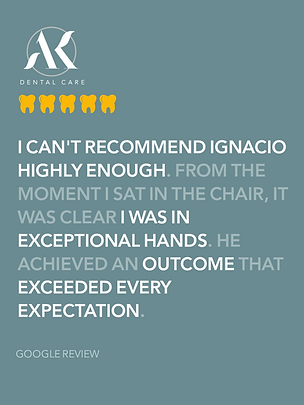
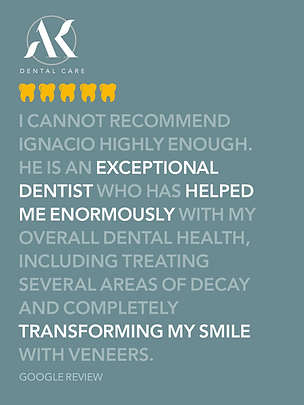

"Ignacio is an exceptional dentist and to date, I don't know another dentist who has as much attention to detail as Ignacio. We are lucky to have him and I am glad our patients appreciate his attention to detail and the quality."
Anish Khatri | Principal Dentist, AK Dental Care
Ready to talk to us?
You don't need to decide whether you need a filling, crown, veneer or something more complex before contacting us.
That is our job to work out with you.
Your restorative consultation gives us the opportunity to understand what concerns you, assess your teeth carefully and explain the options available.
There is no pressure to proceed with treatment.
Our aim is for you to leave understanding what is happening, why it has happened and what your options are.
Restorative consultation with Ignacio: £100
To book a Restorative Consultation, please call 01604 904 670.
Free parking directly outside the practice in Grange Park, Northampton.
Frequently Asked Questions
- 01
- 02
- 03
- 04
- 05
- 06
- 07
- 08
- 09
- 10
- 11
- 12
- 13
- 14
- 15
- 16