


Full Mouth Rehabilitation Case with Ceramics and Implants
A 63-year-old patient presented with generalised tooth wear, multiple failing restorations, and loss of posterior support, resulting in functional instability and compromised aesthetics (Fig 1 and 2). Comprehensive clinical and radiographic assessment indicated the need for a full-mouth adhesive rehabilitation to restore harmony, function, and smile aesthetics while preserving maximal sound tissue.

Treatment provided by Ignacio Farga Niñoles:
Following a diagnostic wax-up (Fig 3) and mock-up validation, a minimally invasive rehabilitation was performed using partial adhesive ceramic restorations. Restorations were bonded under meticulous rubber dam isolation to maximise adhesive reliability (Fig 4 and 5). Upper anterior teeth were restored with v-veneers to enhance aesthetics and function while preserving enamel (Fig 6). Veneerlays were placed on the upper left premolars, lower left premolars, lower right premolars, and lower left molar. Overlays were used on the right molars, and the lower anterior teeth received veneers to restore guidance. An implant was placed in the upper left first molar region, and an implant-supported three-unit bridge extended from the upper right first premolar to the second molar. (Fig 7). The case was subsequently protected with a stabilisation splint in mutually protected occlusion (Fig 8).

Fig 1


Fig 2

Fig 7
Fig 3

Fig 9
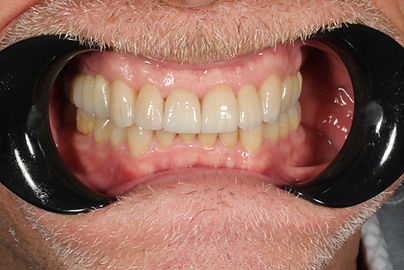
Fig 10
This case demonstrates a conservative lithium disilicate adhesive rehabilitation integrating v-veneers, veneerlays, overlays, and monolithic zirconia implant-supported restorations. The two-year follow-up confirmed excellent functional and aesthetic stability, highlighting the predictability of partial-coverage ceramics for maximal tooth preservation (Fig 9 and 10).